
Статия
What Is Balance and How Can You Train It?
- Начало
- What Is Balance and How Can You Train It?
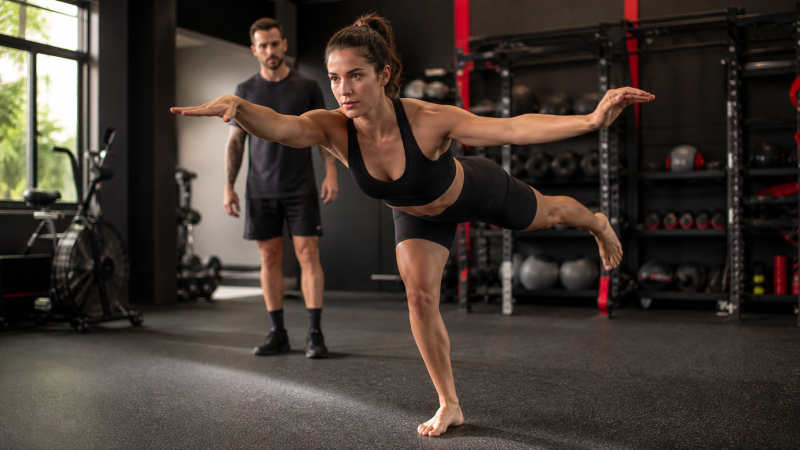
Balance is the ability to control the body in stillness and movement. It is not only relevant to gymnasts or older adults. Every step, squat, change of direction and lifted object requires cooperation between vision, the inner ear, the nervous system, muscles and joints. Balance is a trainable skill.
How does balance work?
The brain combines information from three main sources. Vision shows your position relative to the environment. The vestibular system in the inner ear detects movement and head position. Proprioception supplies information from muscles, tendons and joints. The brain compares these signals and creates a rapid movement response.
When one system is limited, the others work harder. Closing the eyes makes single-leg standing more difficult, while a soft surface reduces reliable information from the foot.
Static and dynamic balance
Static balance means controlling a relatively still position, such as standing on one leg. Dynamic balance means maintaining control while moving: descending stairs, lunging, running or landing. The dynamic component is particularly important in everyday life and sport.
Training should begin with stable static positions and gradually add movement, external resistance and unpredictable tasks.
Why does balance matter?
- it supports confident movement and independence;
- it improves control during resistance exercises;
- it contributes to reactions after a slip or direction change;
- it supports sports skills and landing mechanics;
- it can form part of rehabilitation after appropriate assessment.
Balance training cannot prevent every injury and does not replace strength. It works best alongside resistance exercise, mobility, cardio and specific practice.
A simple home test
Stand beside a stable support, place the arms by the sides and lift one foot. Time how long you hold the position without touching the floor. Repeat on the other side. Small differences are normal, but a large asymmetry, sudden deterioration, dizziness or repeated falls requires professional assessment.
This is not a diagnostic test. Use a safe area and do not close the eyes unless a person or secure support is immediately available.
Core training principles
Progress from a wide to narrow stance, two supports to one, stable to moderately unstable surfaces, and slow to more complex movement. Change one factor at a time. The task should be challenging but controlled rather than chaotic.
Short sessions of 10–15 minutes two to four times per week can be effective. Quality matters more than spending a long time on an unstable ball.
Exercise 1: tandem stance
Place one foot directly in front of the other as if standing on a line. Distribute weight evenly, look forward and breathe normally. Hold for 20–30 seconds and switch. Leave a small gap between the feet to make it easier; add slow head turns to make it harder.
Exercise 2: single-leg stance
Gently engage the hips and trunk without locking the knee. Begin with fingertips on a wall and gradually reduce assistance. Keep the pelvis level and maintain foot contact through the heel and the bases of the big and little toes.
Exercise 3: heel-to-toe walking
Walk along a straight line with the front heel nearly touching the rear toes. Complete 8–12 controlled steps. Look ahead rather than down throughout. Use a hallway with a nearby wall when needed.
Exercise 4: controlled reaches
Stand on one leg and touch the floor with the other foot in front, to the side and behind. Move from the hip while controlling the support knee. Begin with a small range and six repetitions in each direction.
Exercise 5: unilateral strength
Split squats, step-ups, single-leg Romanian deadlifts and one-sided carries develop strength and control. Use stable support, a slow tempo and moderate resistance. Reduce range or load when technique deteriorates.
Do you need unstable surfaces?
Pads, balance boards and balls can add variety but are not essential. Excessive instability reduces the force you can safely produce. A stable floor is usually better for building strength and muscle. Unstable tools have a role in selected tasks and supervised rehabilitation.
Do not perform heavy squats or deadlifts on a ball. Risk increases without a clear additional benefit.
Balance and strength
Weakness in the ankles, hips and trunk can limit control. Squats, lunges, calf raises, rows and carries create a foundation. Balance tasks teach the nervous system to use that strength in specific positions.
Combine a strength exercise with a lighter coordination task. For example, perform step-ups followed by a short single-leg hold.
Balance for older adults
Vision, reactions and muscle strength can decline with age, but training improves function. A strong approach combines lower-body strength, walking, balance tasks and a safe home environment. Lighting, suitable shoes and removing loose rugs also matter.
Previous falls, dizziness or medication affecting blood pressure justify consultation with a doctor and physiotherapist.
Balance for athletes
Sport requires control at speed and under fatigue. Once a stable foundation exists, add landings, changes of direction, throwing and catching, reactions to signals and sport-specific movements. Tasks should resemble the real demands of the activity.
Standing for a long time on an unstable pad does not guarantee better performance on the field. Specificity is decisive.
What can temporarily affect balance?
Fatigue, poor sleep, alcohol, some medications, dehydration and illness may reduce control. If you feel unstable, choose a safer exercise and avoid training near hazards.
Sudden loss of balance accompanied by headache, weakness, speech difficulty, visual disturbance or severe dizziness is an emergency and requires immediate medical attention.
A 10-minute routine
- tandem stance – 2 sets of 30 seconds;
- single-leg stance – 2 sets per side;
- heel-to-toe walking – 3 passes;
- controlled reaches – 2 sets of 6;
- low step-ups – 2 sets of 8 per leg.
Work near a stable support. When the routine becomes easy, increase time or range, but not every variable at once.
How to progress safely
First improve duration and consistency. Next narrow the base, add gentle head movement or introduce a controlled reach. Later, add a light external load or a simple cognitive task. Keep the environment predictable when learning. A small loss of position is expected, but repeated uncontrolled stepping means the variation is too difficult.
Balance after an ankle injury
An ankle sprain can reduce proprioception and confidence. Rehabilitation often progresses from range of motion and strength to single-leg control, reaching, hopping and sport-specific direction changes. The exact progression depends on injury severity and should be guided by a clinician when pain, swelling or instability persists.
Common mistakes
- choosing a difficult variation without safe support;
- holding the breath and creating excessive tension;
- using only unstable equipment;
- neglecting lower-body strength;
- closing the eyes too early;
- ignoring dizziness or sudden change.
Frequently asked questions
How often should I train balance?
Two to four short sessions per week are practical. Easy tasks may be used more often in a safe environment.
Does yoga improve balance?
Yes. Many poses develop control and mobility, although resistance training and specific movement tasks also matter.
Should I train barefoot?
It is not required. Barefoot work may increase sensory feedback, but suitable shoes are safer in some situations.
Is it normal for one leg to be steadier?
Small differences are common. Large or sudden asymmetries deserve professional assessment.
Conclusion
Balance combines sensory information, strength, coordination and practice. Begin with safe positions, gradually add movement and pair the tasks with resistance training. Consistent short sessions improve confidence and control more effectively than rare complicated exercises.