
Статия
Plank Exercise: Correct Form, Mistakes and Progressions
- Начало
- Plank Exercise: Correct Form, Mistakes and Progressions
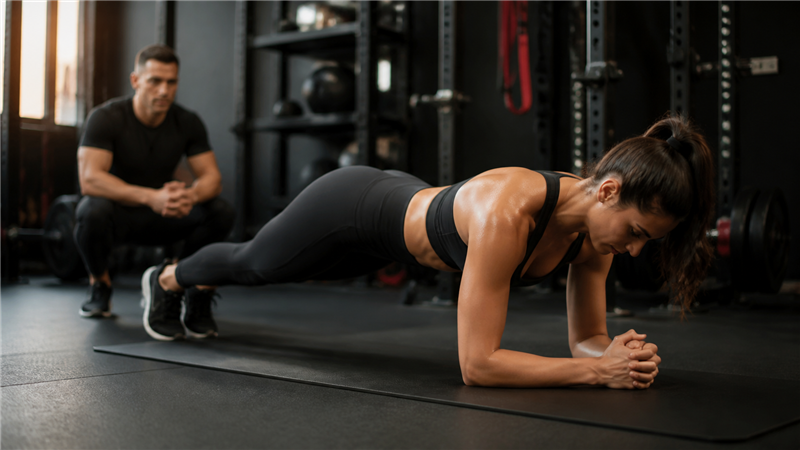
The plank is an isometric exercise in which the body maintains a stable position instead of repeating a movement. It looks simple, but sound technique requires cooperation between the abdominal muscles, glutes, shoulder girdle, and breathing. The goal is not a record at any cost; it is quality tension in a position you can control.
Which muscles work?
The plank trains the rectus abdominis, obliques, and deeper stabilisers. The shoulders and forearms support the upper body, while the glutes and thighs control the pelvis. The back works as part of the system, but sharp lower-back pain is not a normal target sensation.
A stable trunk transfers force between the upper and lower body during squats, deadlifts, push-ups, running, and daily movement. The plank is one tool for this purpose, not the only required exercise.
How to perform a forearm plank
- place the elbows approximately under the shoulders;
- extend the legs and support yourself on the toes;
- create a straight line from head to heels;
- tighten the glutes and gently tuck the pelvis;
- press the forearms into the floor and keep shoulders away from ears;
- look at the floor to maintain a neutral neck;
- breathe calmly without losing position.
Begin with 10 to 20 seconds. End the set when the hips sag, the lower back arches, or breathing becomes impossible. A short quality set is better than a long incorrect hold.
Common mistakes
Sagging hips
When the abdomen and glutes relax, the lower back arches. Reduce time, use a knee plank, or elevate the arms.
Hips too high
This makes the exercise easier for the abdomen and changes the movement. Imagine one line through shoulders, hips, and heels.
Looking forward
Lifting the head stresses the neck. Look at the floor and keep the chin gently tucked.
Holding the breath
A plank should allow controlled breathing. Exhale slowly without releasing abdominal tension.
Knee plank for beginners
Place the knees on a mat and create a straight line from head to knees. Tighten the glutes and keep elbows under shoulders. This is not a poor version; it is a way to practise the correct position.
Perform three sets of 15 to 25 seconds. When all are stable, try a standard plank for ten seconds and build gradually.
Elevated plank
Place the forearms or hands on a bench. A higher support makes the exercise easier. This version is convenient for learning and for someone who cannot comfortably move to the floor.
Reduce the height gradually. Do not rush to the floor when position is lost.
Side plank
The side plank trains the obliques and hip stabilisers. Place the elbow under the shoulder, use bent knees or straight legs, and lift the hips. Keep the head, ribs, and pelvis aligned.
Begin with 10 to 20 seconds per side. If the shoulder hurts, check the setup and use an easier version. Sharp pain is a reason to stop.
High plank
The high plank uses the top position of a push-up. Hands are under the shoulders, elbows are not forcefully locked, and the floor is pushed away. It loads the wrists more than the forearm version.
With wrist discomfort, consider handles, stable flat-sided dumbbells, or the forearm variation when appropriate.
Dynamic variations
After mastering the standard hold, add shoulder taps, leg lifts, transitions between elbows and hands, or lateral movement. The goal is to keep the pelvis as stable as possible.
Begin with a small range and slow repetitions. If the body rotates excessively, widen the feet or return to an easier version.
How long should you hold?
For most purposes, high-quality sets of 15 to 45 seconds are enough. When more than a minute becomes easy, selecting a harder variation is often more useful than chasing several minutes.
Perform two to four sets, two or three times per week. Abdominal muscles also need recovery and varied training.
Does the plank create visible abs?
It strengthens and may develop the core, but it cannot remove fat only from the abdomen. Visible abs depend on muscle size, overall body fat, and genetics. A complete nutrition and training plan is required.
Do not use planks as the main calorie-burning method. Full-body resistance training, cardio, and daily movement contribute more to total expenditure.
Planks and back pain
A plank may form part of a stability programme, but it does not automatically treat pain. Back pain has many causes, and one version is not suitable for everyone. Seek medical assessment for persistent, severe, or radiating pain.
Use a variation that does not provoke symptoms. A qualified physiotherapist or trainer can help design an individual progression.
A four-week progression
- week 1 – three sets of 15 seconds from the knees;
- week 2 – three sets of 20 to 25 seconds;
- week 3 – four sets of 15 to 20 seconds in a standard plank;
- week 4 – three sets of 25 to 35 seconds plus side planks.
Progress only when position remains stable. Return to the previous step with fatigue or pain.
Adding planks to a workout
Perform planks after the main strength exercises so the core is not exhausted before heavy squats or deadlifts. A brief submaximal set can also be part of a warm-up. Combine planks with anti-rotation work, loaded carries, and controlled spinal movement.
Making the plank harder without more time
Increase full-body tension by pulling the elbows gently toward the toes without moving. Narrow the stance, use a longer lever, add a controlled limb lift, or choose a stability-ball variation only when the foundation is strong.
Added resistance should be used cautiously and ideally with supervision. A weight plate on the back is unnecessary for most people and can be difficult to position safely.
Frequently asked questions
Can I plank every day?
Frequent low-volume practice may be fine, but two or three quality days are enough for many people.
Is a plank better than sit-ups?
They train the trunk differently. A good programme may use several appropriate movements.
Why does my lower back hurt?
The hips may be sagging or the variation may be too difficult. Stop with pain and seek assessment if it continues.
How many seconds are enough?
Fifteen to 45 quality seconds are practical. Do not sacrifice position for a record.
Should I feel the plank in my shoulders?
The shoulders work, but sharp pain is not normal. Check elbow position, push the floor away, and regress if needed.
Conclusion
The plank is an effective trunk-stability tool when performed with a sound body line, active glutes, and calm breathing. Begin with a suitable regression, progress gradually, and choose a harder variation when long holds become easy. Combine it with a complete programme instead of expecting one exercise to solve everything.